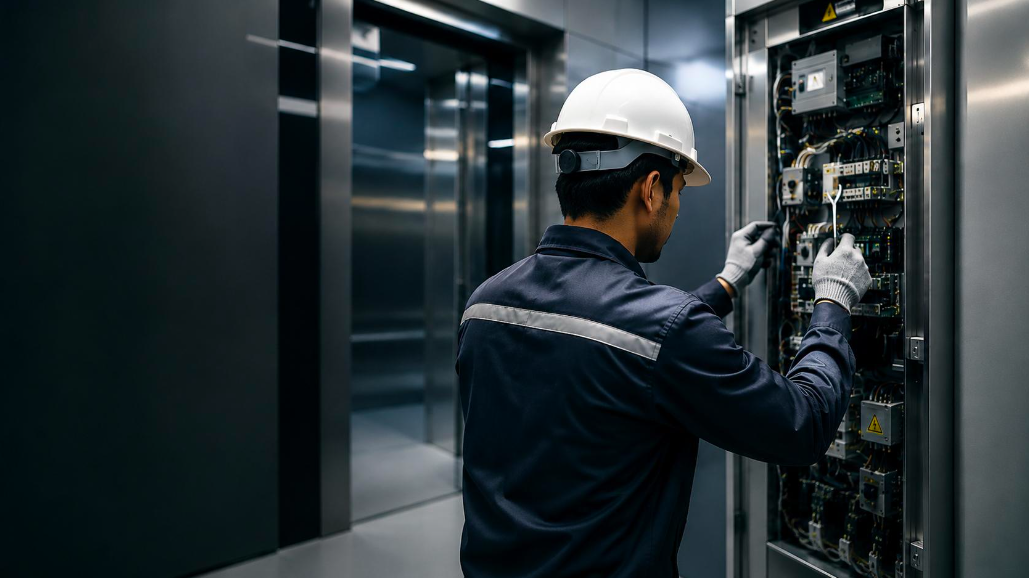
Why is elevator maintenance important?
An elevator is one of the most frequently used systems in a residential or commercial building.
In an apartment complex, it connects residents to their homes. In an office, it supports daily movement between floors. In a hospital, its availability can directly affect the movement of patients and medical staff.
Yet many building owners think about elevator maintenance only when something goes wrong.
A better approach is to maintain the elevator through a planned maintenance programme.
This is where an Annual Maintenance Contract (AMC) becomes important.
What is an elevator AMC?
An elevator AMC is a service agreement between a building owner or facility manager and an elevator maintenance company.
It defines the maintenance services, responsibilities, coverage, exclusions and commercial terms for maintaining the elevator over an agreed period.
Depending on the contract, it may include:
- Scheduled preventive maintenance
- Inspection of mechanical and electrical components
- Door operation checks
- Control panel checks
- Safety system checks
- Breakdown support
- Lubrication and adjustments
- Replacement of specified components
- Emergency assistance
Not every AMC includes the same services. The actual coverage must be checked in the written agreement.
What does preventive elevator maintenance include?
Preventive maintenance aims to identify developing issues before they cause a breakdown.
Here are some important areas that qualified elevator technicians may examine.
1. Elevator doors
Door operation is a common source of passenger complaints. Technicians should inspect door movement, sensors, locks and related mechanisms.
2. Control system
The controller manages elevator operations. Its condition, connections and fault history should be reviewed.
3. Motor and drive system
The drive arrangement should be inspected according to the elevator’s technology and manufacturer recommendations.
4. Braking system
Brakes are safety-critical components and require appropriate inspection and servicing by competent personnel.
5. Safety devices
Safety circuits, emergency communication, alarm systems and other safety devices should be checked according to the maintenance procedure.
6. Levelling accuracy
The elevator should stop appropriately at the landing so passengers can enter and exit safely.
7. Shaft and pit
The shaft, pit and associated components should be inspected by trained personnel following appropriate safety procedures.
What is the difference between comprehensive and non-comprehensive AMC?
| Feature | Comprehensive AMC | Non-comprehensive AMC |
|---|---|---|
| Scheduled maintenance | As contracted | As contracted |
| Labour | Check contract | Check contract |
| Routine servicing | As contracted | As contracted |
| Spare parts | Coverage depends on exclusions | Often charged separately |
| Major component replacement | Verify explicitly | Usually separately charged |
| Breakdown support | Check response terms | Check response terms |
The terms used by different companies may vary. Always compare the actual written scope rather than relying on the contract name.
How often should an elevator be serviced?
There is no single servicing frequency suitable for every elevator.
It depends on:
- Elevator type
- Passenger traffic
- Operating hours
- Equipment condition
- Manufacturer recommendations
- Applicable regulatory requirements
BIS’s IS 17900 series includes Part 6, a guide for lift maintenance.
Maintenance should be planned by competent technicians and aligned with the relevant requirements for the installation.
Seven questions to ask before signing an elevator AMC
- How many preventive maintenance visits are included?
- Is breakdown attendance included?
- What is the promised response time?
- Are spare parts included?
- Are major components excluded?
- Is emergency assistance available?
- Will service reports and maintenance records be provided?
Why should building owners avoid waiting for a breakdown?
An elevator breakdown can inconvenience residents, employees, visitors and customers.
In hospitals and other critical facilities, downtime can create additional operational difficulties.
A structured maintenance arrangement helps building owners monitor equipment condition, identify recurring faults and plan corrective work.
Frequently asked questions
What is elevator AMC?
An elevator Annual Maintenance Contract is an agreement for scheduled maintenance and other specified service support over a defined period.
Does an elevator AMC cover all spare parts?
Not necessarily. Coverage depends on whether the agreement is comprehensive and which components are included or excluded.
Can an old elevator be maintained under an AMC?
Potentially, yes. However, equipment condition, obsolete components and availability of spare parts need to be assessed.
Who should maintain an elevator?
Elevator maintenance should be carried out by competent, trained personnel familiar with the specific installation and applicable safety requirements.
Is your building’s elevator receiving regular maintenance?
Professional Elevators provides elevator solutions across residential, commercial and industrial applications.
Speak with the team about maintenance requirements and the appropriate service arrangement for your elevator.
Internal links:
External references: