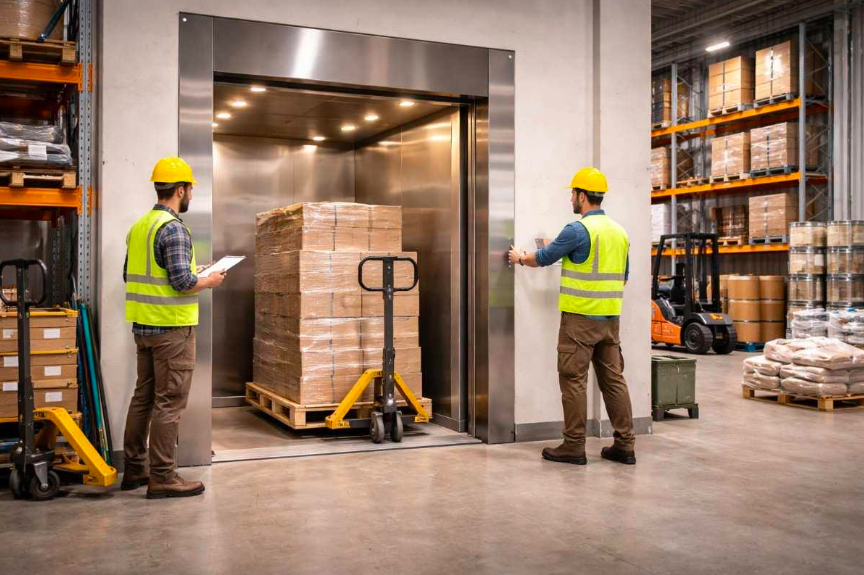
Factories, warehouses, manufacturing facilities and commercial buildings often need elevators to move materials and equipment between floors.
But should you install a passenger elevator or a dedicated goods lift?
Although both systems provide vertical transportation, their intended applications are different.
Choosing the right elevator is important for operational efficiency, safety and long-term performance.
What is a goods lift?
A goods lift is designed primarily for transporting materials, products, equipment and other loads between floors.
Typical applications include:
- Manufacturing facilities
- Warehouses
- Industrial buildings
- Shopping malls
- Commercial kitchens
- Distribution centres
- Storage facilities
Professional Elevators offers Goods Elevators for material transportation applications.
What is a passenger elevator?
A passenger elevator is designed to transport people between floors.
It is commonly installed in:
- Apartments
- Offices
- Hotels
- Hospitals
- Commercial buildings
- Educational institutions
Explore Passenger Elevators.
Goods lift vs passenger lift: Key differences
| Comparison | Goods lift | Passenger lift |
|---|---|---|
| Primary purpose | Material transportation | Passenger transportation |
| Main users | Operators and authorised personnel, as permitted by design | Building occupants and visitors |
| Application | Factories, warehouses, commercial facilities | Homes, offices, apartments |
| Load requirements | Based on goods and handling equipment | Based on passenger capacity |
| Cabin design | Based on the type of materials transported | Designed for passenger comfort and accessibility |
| Door configuration | Based on loading requirements | Based on passenger access |
| Selection | Material dimensions, weight and loading | Occupancy and passenger traffic |
The actual permitted use and safety configuration must always follow the elevator’s approved design and applicable regulations.
1. Understand what you need to transport
Before selecting a goods lift, consider:
- Maximum weight
- Dimensions of the largest load
- Type of material
- Trolley or pallet movement
- Loading and unloading arrangements
- Number of trips per day
For example, transporting small cartons is very different from moving heavy industrial components.
2. Evaluate the number of floors
A goods lift serving two floors in a factory may have different technical requirements from one serving several levels in a warehouse.
Consider total travel height and the expected frequency of operation.
3. Consider loading and unloading
The elevator should integrate with the facility’s internal material-handling process.
Ask:
- Will goods be moved manually?
- Will trolleys enter the cabin?
- Is pallet movement required?
- How much space is available outside the lift?
- Will multiple departments use the elevator?
4. Choose the correct capacity
The capacity should be based on the maximum intended load, including handling equipment where applicable.
Do not estimate capacity simply by looking at cabin size.
5. Prioritise safety
Goods lifts should be designed and operated for their intended purpose.
Consider appropriate door interlocks, overload protection, emergency systems and operational safeguards.
The applicable Indian lift standards include provisions for the transport of persons and goods under the IS 17900 series. Refer to BIS lift standards.
6. Plan the installation early
The structural team should coordinate with the elevator manufacturer on:
- Shaft dimensions
- Pit and overhead
- Landing arrangements
- Structural loading
- Electrical requirements
- Installation access
This helps avoid expensive changes during construction.
7. Think about maintenance
A goods lift in a manufacturing facility may experience intensive usage.
The maintenance strategy should reflect the operating environment and usage frequency.
Which elevator should your industrial building choose?
Choose a goods lift when the primary requirement is material transportation.
Choose a passenger lift when the primary requirement is moving people.
Some larger facilities may need both, with each elevator serving a clearly defined function.
Frequently asked questions
Can a goods lift carry people?
Only if it is specifically designed, approved and certified for that use under applicable requirements. A conventional goods-only lift must not be treated as a passenger elevator.
What capacity goods lift does a factory need?
It depends on the heaviest intended load, material dimensions, handling equipment and frequency of operation.
Can goods lifts be installed in existing buildings?
Potentially, yes. The building structure, available space, loading requirements and applicable approvals must first be assessed.
Need a goods lift for your factory or warehouse?
Professional Elevators offers goods elevator solutions for industrial and commercial applications.
Discuss your load requirements, floor count and building layout with the team.
Internal links:
External references: