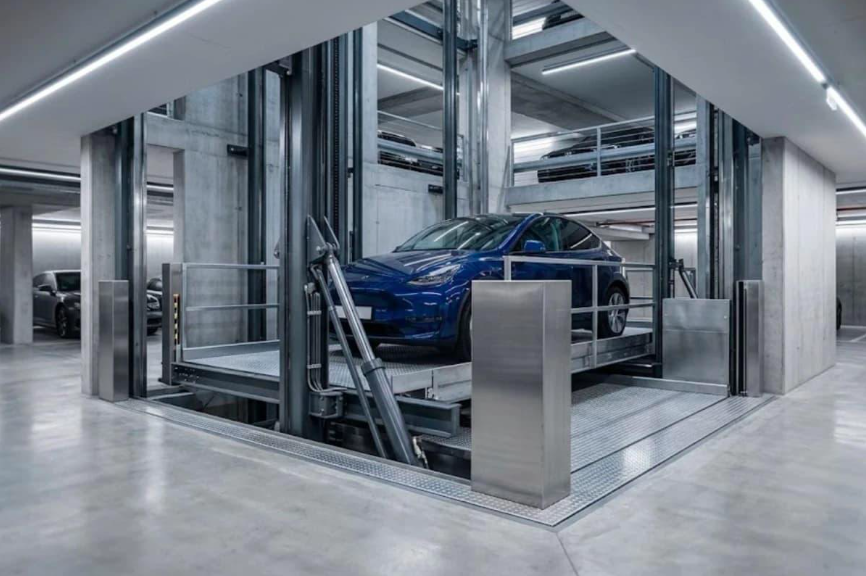
Space is becoming an increasingly important consideration in urban construction.
In cities such as Chennai, Bengaluru, Hyderabad and Kochi, developers and property owners often need to make better use of available building space.
Automobile elevators provide a way to move vehicles vertically between floors, making them useful for selected commercial, residential and industrial applications.
But a car elevator is not simply a larger passenger lift.
It requires careful planning around vehicle dimensions, weight, access, loading arrangements and building design.
What is a car elevator?
A car elevator, also called an automobile elevator, is a specialised vertical transportation system designed to move vehicles between different levels of a building.
It can be considered for:
- Automobile showrooms
- Car service centres
- Multi-level parking facilities
- Residential developments
- Commercial properties
- Vehicle display spaces
Professional Elevators offers Automobile Elevators.
How does an automobile elevator work?
The vehicle enters the elevator platform or cabin at the designated landing.
The elevator then transports the vehicle to the selected floor, where it can exit according to the installation’s operating procedure.
The configuration depends on the building and the vehicle requirements.
The elevator should be designed for the specified vehicle dimensions, maximum load and operating conditions.
6 important factors when planning a car elevator
1. Vehicle dimensions
Consider the maximum length, width and height of the vehicles expected to use the lift.
2. Vehicle weight
The system should be selected according to the maximum permitted vehicle load.
3. Entry and exit arrangement
Approach space, turning radius, ramp arrangement and vehicle alignment must be considered.
4. Shaft and structural requirements
The building must accommodate the elevator’s technical requirements and structural loading.
5. Safety arrangements
Vehicle restraint and positioning procedures, door interlocks, overload protection, emergency systems and appropriate operational controls should be considered.
6. Frequency of usage
A showroom with frequent vehicle movement may have different operational requirements from a residential building with occasional vehicle movement.
Where are car elevators useful?
Automobile showrooms
Vehicles can be moved between display floors without relying entirely on conventional ramps.
Multi-level parking facilities
They can provide vertical vehicle movement where the building design supports this approach.
Car service centres
Vehicles may need to move between inspection, servicing and storage levels.
Residential and commercial buildings
Selected projects may use automobile elevators where vehicle movement between levels is part of the building plan.
Car elevator vs conventional car parking ramp
| Factor | Car elevator | Conventional ramp |
|---|---|---|
| Vertical movement | Mechanical elevator system | Vehicle drives up or down |
| Floor space | Requires elevator shaft and access area | Requires ramp length and circulation |
| Vehicle movement | Controlled elevator operation | Continuous vehicle movement |
| Design considerations | Lift capacity, cabin and safety systems | Gradient, turning and ramp geometry |
| Best suited to | Projects where vertical vehicle transport is appropriate | Buildings with sufficient ramp space |
Neither solution is universally better. The building layout, vehicle traffic, operating costs and safety arrangements should guide the decision.
What should architects consider before specifying a car elevator?
Involve the elevator manufacturer during the initial building-planning stage.
The architect and structural engineer should coordinate:
- Vehicle dimensions and load
- Elevator location
- Shaft dimensions
- Pit and overhead
- Landing access
- Electrical requirements
- Entry and exit circulation
- Emergency access
- Maintenance provisions
This is particularly important for projects where space is limited.
Frequently asked questions
Can a car elevator be installed in an existing building?
It may be possible, subject to structural feasibility, available space, vehicle access and applicable permissions.
Can a car elevator accommodate SUVs?
The elevator must be specified according to the maximum vehicle dimensions and weight. SUV compatibility should be confirmed from the technical drawings.
Are automobile elevators suitable for residential buildings?
They may be appropriate for selected residential projects, depending on building design, parking requirements and vehicle movement needs.
Planning a building that needs vertical vehicle transportation?
Professional Elevators provides automobile elevator solutions for suitable building applications.
Discuss your vehicle dimensions, site layout and project requirements before finalising the design.
Request a Project Consultation
Internal links:
External references: